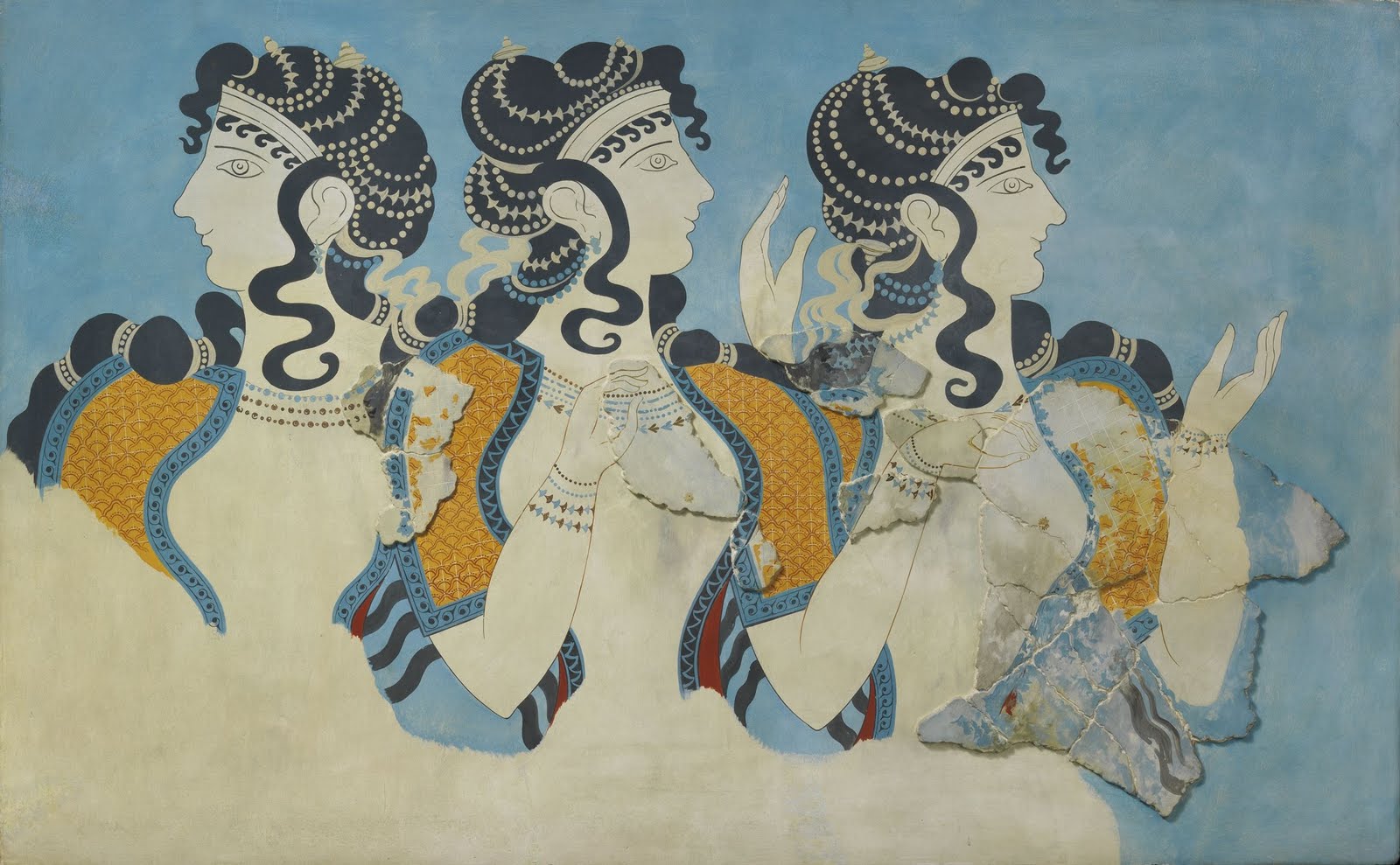
“Illustrious Eumenides […] whose piercing sight with vision unconfined surveys the deeds of all the impious kind. On fate attendant, punishing the race with wrath severe, of deeds unjust and base […] eternal rulers, terrible and strong, to whom revenge and tortures dire belong; fateful, and horrid to the human sight.”
Not a ritual playlist, but one that tunes me into the swamp I so love. A nice blend of southern gothic, rock, and blues – all of which are mostly current songs. Perhaps my fellow swamp witches might enjoy.
This is a seal I created to honor the Minoan Great Goddess – and a few of her known aspects: the Solar Bull, The Huntress/Keeper of Wilds, the Snake Goddess – as well as symbols representing the Moon and the Liminal Spaces to honor the Mistress of the Labyrinth.
Sculpt an oval out of clay, engrave or paint the following symbol on its face and drive through the amulet an iron nail downward from the top of the amulet to the bottom – not disrupting its face. Fire/dry/bake. Tie a cord around the nail head and wear it – when any yells or makes you uncomfortable, tap its face three times to lay a hex on their head.
Note, this is not in itself a protection amulet, though it could be formulated to include the facility. As is, it is just to punish any transgressors – best when paired with an autonomous protection amulet.
My dreams recently have been leading. For a while now, I’ve
wanted to write something on the “Ariadne,” or more accurately, the Mistress of the Labyrinth from Minoan
lore. I’ve always been fascinated by Minoan religion for a number of reasons.
Foremost being their exclusively matriarchal pantheon that served for much
inspiration in regards to most of the Greek goddesses. I probably also love it
in no small part for the great mystery that still surrounds it – what with
Linear A and the Cretan hieroglyphs still yet indecipherable. I can’t help it –
I love a good mystery. And recently, I’ve sought to explore and explain it
through a most interesting source – one that existed a world away. As such, I’ll
preface this by saying this is very much theoretical – I can produce no
concrete evidence, but nonetheless, I find it interesting. And as they say, you
can’t apply evidence without first framing a hypothesis.
Given the obscuration still surrounding the Minoan mythos,
we must first begin with its successor – and most importantly with the myth of
Persephone, which I’m sure most of you are familiar with. Both of her “aspects”
– as an agricultural/fertility goddess and a chthonic one – are very important
for the correlations I will make in regards to the Aztec pantheon. While the
similarity is obvious, it’s not extraordinarily well noted in regards to the
Aztec goddess Xochiquetzal, who undergoes a nearly identical circumstance. She,
too, was an agricultural/fertility goddess before her abduction by Tezcatlipoca
– at which point she was irrevocably forced into chthonic divinity. And while
these similarities in and of themselves are interesting, the real weight comes
with their elder counterparts, as both are believed to be manifestations of
elder figures reworked into the framework of inclusive faiths. Looking at
Xochiquetzal, I believe, might grant insight into the history of Persephone –
given the obvious enough similarity.
It’s been postulated that Xochiquetzal may in fact be tied
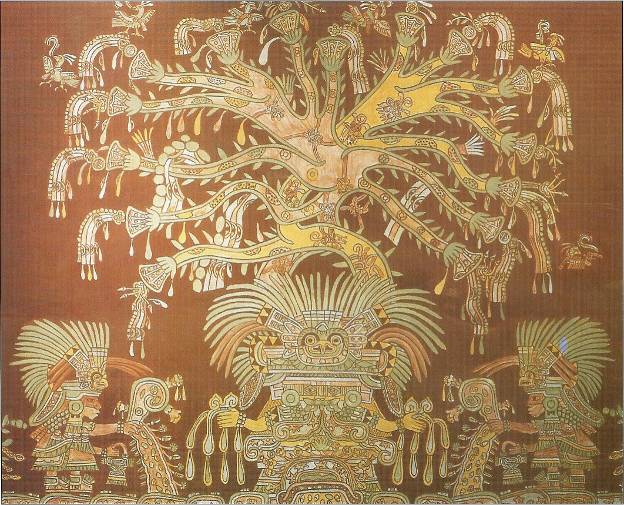
to the unnamed Spider Goddess of Teotihuacan – who is an interesting figure in
her own right. She was thought to be a Great Goddess, an instrument in the
creation of man and was rightly also tied to agriculture and fertility (as well
as being tied to War) – though most intriguingly, she most often appears
bedecked in characteristic items and dress (as well as with animals) that were all
characteristic Mesoamerican symbols of the Underworld (including but not
limited to both the Spider and the Jaguar). While her worship seemed to be quite
local (reserved mostly to Teotihuacan, wherein she acted as patroness), I would
argue her archetype would most probably be left over from older beliefs. As
such, it would make sense for this duality to persist on into the Aztec
incarnation of Xochiquetzal – who existed dually in the same capacity. Of
course, given her abduction, this capacity would no longer be innate –
something that can be seen with the patriarchal overthrow of the matriarchy. I
would posit that undoubtedly, in both regards these “abductions” were but a way
to explain the already existing nature of these beings, but with a way to incorporate
male divinity as justification. Assuming the correlation between Xochiquetzal
and the Spider Goddess is rightly, I think we can assume that Persephone
undoubtedly existed similarly as a Great Goddess before her annexation.
I’m inclined to believe that Persephone and Ariadne are in
fact two heads of the same coin – both later aspects of who had been called The Mistress of the Labyrinth. While
Ariadne’s story is far more obviously related (as the daughter of King Minos of
Knossos, and her story featuring the Cretan Labyrinth and the Minotaur – which on
a side note was no doubt related to the bull worship that seemed to be a common
Minoan practice), the Chthonic aspect thusly suggest to me a correlation – which
is in no small part also due to the Aztec mythology, specifically that
surrounding Tezcatlipoca and divination. It has been noted that the Aztecs used
obsidian mirrors to scry, the act of which was likened to fire caught in a pool
of water (as the obsidian was often placed on the bottom of a vessel that was
then filled with water, the visions therein were the “fire.”) This concept
extends to the idea of a butterfly caught within a spider’s web. The Aztecs
held spiders to be related to water – given the fractal waves can be reminiscent
of a web, and the butterfly related to fire. Not surprisingly, one of the
animals associated with Xochiquetzal was the butterfly (and as previously
mentioned, the Spider in her previous incarnation – further cutting
Tezcatlipoca’s true relevance down). But it was not only the Aztecs who revered
butterflies, but the Minoans – as the labyrs. The double-headed ax and the
butterfly – both of which being symbols of their Great Goddess, The Huntress. Unsurprisingly, based on
her name, Artemis (and Rhea) were most probably born from her. She was known to
be the keeper of wilds, guardian of animals and made her home in/on the
mountain (it was in the mountains that the system of sacred, labyrinthine caves
existed – which will prove to be important later) – it’s also important to note
that the Great Goddess acted as creator immaculately, reminiscent of Artemis as
a Virgin Goddess and Rhea as Mother Goddess.
Fun Fact: Artemis and Xochiquetzal are both twins. Their
brothers. Apollo(n) and Xochipilli, both act as solar, entheogenically-inclined,
oracular deities – relating to arts, markets, music, enlightenment and homosexuality
– though Apollo wasn’t the only one.
With this, we have presented The Huntress, the butterfly, and the Mistress of the Labyrinth, the spider (which weaves labyrinthine
webs). Agricultural/fertility and chthonic, respectively. My theory is that,
while both of these Goddesses were unique, they were aspects of one another. The Huntress – as Artemis, Rhea, Kore/Demeter,
even Xochiquetzal – were the lighter aspects. The Mistress of the Labyrinth,
alternately, represents the darker and more mysterious, chthonic aspects of the
Great Goddess – such as with Persephone, the other half of the Spider Goddess
(perhaps as Tezcatlipoca), and Ariadne. The
Huntress is the Mountain, and The
Mistress is the Cave. As such, it would not surprise me if the entire
Minoan pantheon were merely aspects of a singular, Great Goddess – whose aspects
were adopted into polytheistic Gods by the so-inclined Greeks (such as Hera,
Demeter, Artemis, Athena, etc.). I think with time there will be discoveries
made to back this conclusion up, though I highly doubt they’ll compare them to
an “autonomous” pantheon such as the Aztecs. But rest assured, I will be eagerly
awaiting new evidence to surface and Linear A to finally be deciphered!
Okay so I’m sort of flipping shit right now because all of the animals & goddesses (including archetypes) mentioned in this posy have been showing up repeatedly /very/ aggressively through signs & dreams & I don’t know what any of that means for me because they only show up in regards to myself–as in I’m related to all of these things too??
This is EXACTLY what has been happening to me for years. I still haven’t wholly cracked the code, but I’m working on it. Feel free to message me about it!!
What have you figured out so far? A lot of different goddesses from a bunch of pantheons I noticed are beginning to have similar aspects, like war, fertility, death, agriculture, hunting/hunter
I feel like this all started for me when I woke up from a nap with the name Inanna on my mind (I didn’t remember what kind of dream I had beforehand, just that name)
Also I noticed my companion likes to send me spiders, & the animal I associate with him is the jaguar/bear/tiger/bat, & possibly large canine related animals too, as well as bulls. Like some male fertility god (to my female nonetheless lmao)
Also I noticed I have a strange connection to the moon, especially it’s darker aspects, but it’s a minor one compared to the hunting, fertility, sex, & war aspects I’ve been getting. The dark moon/black queen deals with more journey-path working-shadow workings type thing, very internal.
It’s funny you should mention Innana – because I thought about including she and Ereshkigal in the original post. Undoubtedly the duality of the two and their own symbolism are similar to the above mentioned. I actually thought it may have been Ereshkigal whom I had met in a dream some years ago, but since then – having worked with her – I now know her to be different. She was the top contender for awhile – because of her similarity!
I’d say the moon/black queen bit would undoubtedly relate to “Ariadne” (The Mistress of the Labyrinth). Because while you undoubtedly have the chthonic connotations, sorcery, etc., you also have the sense of the labyrinth of the subconscious – which is very internal. It goes back to how most Gods/Goddesses have that other duality, as well – their own existence as both outward figures and internal notions/concepts. They can affect in both regards.
My dreams recently have been leading. For a while now, I’ve
wanted to write something on the “Ariadne,” or more accurately, the Mistress of the Labyrinth from Minoan
lore. I’ve always been fascinated by Minoan religion for a number of reasons.
Foremost being their exclusively matriarchal pantheon that served for much
inspiration in regards to most of the Greek goddesses. I probably also love it
in no small part for the great mystery that still surrounds it – what with
Linear A and the Cretan hieroglyphs still yet indecipherable. I can’t help it –
I love a good mystery. And recently, I’ve sought to explore and explain it
through a most interesting source – one that existed a world away. As such, I’ll
preface this by saying this is very much theoretical – I can produce no
concrete evidence, but nonetheless, I find it interesting. And as they say, you
can’t apply evidence without first framing a hypothesis.
Given the obscuration still surrounding the Minoan mythos,
we must first begin with its successor – and most importantly with the myth of
Persephone, which I’m sure most of you are familiar with. Both of her “aspects”
– as an agricultural/fertility goddess and a chthonic one – are very important
for the correlations I will make in regards to the Aztec pantheon. While the
similarity is obvious, it’s not extraordinarily well noted in regards to the
Aztec goddess Xochiquetzal, who undergoes a nearly identical circumstance. She,
too, was an agricultural/fertility goddess before her abduction by Tezcatlipoca
– at which point she was irrevocably forced into chthonic divinity. And while
these similarities in and of themselves are interesting, the real weight comes
with their elder counterparts, as both are believed to be manifestations of
elder figures reworked into the framework of inclusive faiths. Looking at
Xochiquetzal, I believe, might grant insight into the history of Persephone –
given the obvious enough similarity.
It’s been postulated that Xochiquetzal may in fact be tied
to the unnamed Spider Goddess of Teotihuacan – who is an interesting figure in
her own right. She was thought to be a Great Goddess, an instrument in the
creation of man and was rightly also tied to agriculture and fertility (as well
as being tied to War) – though most intriguingly, she most often appears
bedecked in characteristic items and dress (as well as with animals) that were all
characteristic Mesoamerican symbols of the Underworld (including but not
limited to both the Spider and the Jaguar). While her worship seemed to be quite
local (reserved mostly to Teotihuacan, wherein she acted as patroness), I would
argue her archetype would most probably be left over from older beliefs. As
such, it would make sense for this duality to persist on into the Aztec
incarnation of Xochiquetzal – who existed dually in the same capacity. Of
course, given her abduction, this capacity would no longer be innate –
something that can be seen with the patriarchal overthrow of the matriarchy. I
would posit that undoubtedly, in both regards these “abductions” were but a way
to explain the already existing nature of these beings, but with a way to incorporate
male divinity as justification. Assuming the correlation between Xochiquetzal
and the Spider Goddess is rightly, I think we can assume that Persephone
undoubtedly existed similarly as a Great Goddess before her annexation.
I’m inclined to believe that Persephone and Ariadne are in
fact two heads of the same coin – both later aspects of who had been called The Mistress of the Labyrinth. While
Ariadne’s story is far more obviously related (as the daughter of King Minos of
Knossos, and her story featuring the Cretan Labyrinth and the Minotaur – which on
a side note was no doubt related to the bull worship that seemed to be a common
Minoan practice), the Chthonic aspect thusly suggest to me a correlation – which
is in no small part also due to the Aztec mythology, specifically that
surrounding Tezcatlipoca and divination. It has been noted that the Aztecs used
obsidian mirrors to scry, the act of which was likened to fire caught in a pool
of water (as the obsidian was often placed on the bottom of a vessel that was
then filled with water, the visions therein were the “fire.”) This concept
extends to the idea of a butterfly caught within a spider’s web. The Aztecs
held spiders to be related to water – given the fractal waves can be reminiscent
of a web, and the butterfly related to fire. Not surprisingly, one of the
animals associated with Xochiquetzal was the butterfly (and as previously
mentioned, the Spider in her previous incarnation – further cutting
Tezcatlipoca’s true relevance down). But it was not only the Aztecs who revered
butterflies, but the Minoans – as the labyrs. The double-headed ax and the
butterfly – both of which being symbols of their Great Goddess, The Huntress. Unsurprisingly, based on
her name, Artemis (and Rhea) were most probably born from her. She was known to
be the keeper of wilds, guardian of animals and made her home in/on the
mountain (it was in the mountains that the system of sacred, labyrinthine caves
existed – which will prove to be important later) – it’s also important to note
that the Great Goddess acted as creator immaculately, reminiscent of Artemis as
a Virgin Goddess and Rhea as Mother Goddess.
Fun Fact: Artemis and Xochiquetzal are both twins. Their
brothers. Apollo(n) and Xochipilli, both act as solar, entheogenically-inclined,
oracular deities – relating to arts, markets, music, enlightenment and homosexuality
– though Apollo wasn’t the only one.
With this, we have presented The Huntress, the butterfly, and the Mistress of the Labyrinth, the spider (which weaves labyrinthine
webs). Agricultural/fertility and chthonic, respectively. My theory is that,
while both of these Goddesses were unique, they were aspects of one another. The Huntress – as Artemis, Rhea, Kore/Demeter,
even Xochiquetzal – were the lighter aspects. The Mistress of the Labyrinth,
alternately, represents the darker and more mysterious, chthonic aspects of the
Great Goddess – such as with Persephone, the other half of the Spider Goddess
(perhaps as Tezcatlipoca), and Ariadne. The
Huntress is the Mountain, and The
Mistress is the Cave. As such, it would not surprise me if the entire
Minoan pantheon were merely aspects of a singular, Great Goddess – whose aspects
were adopted into polytheistic Gods by the so-inclined Greeks (such as Hera,
Demeter, Artemis, Athena, etc.). I think with time there will be discoveries
made to back this conclusion up, though I highly doubt they’ll compare them to
an “autonomous” pantheon such as the Aztecs. But rest assured, I will be eagerly
awaiting new evidence to surface and Linear A to finally be deciphered!
Okay so I’m sort of flipping shit right now because all of the animals & goddesses (including archetypes) mentioned in this posy have been showing up repeatedly /very/ aggressively through signs & dreams & I don’t know what any of that means for me because they only show up in regards to myself–as in I’m related to all of these things too??
This is EXACTLY what has been happening to me for years. I still haven’t wholly cracked the code, but I’m working on it. Feel free to message me about it!!


 The Qedavian Apocrypha