‘Naming’ the Unnamed

Some months ago I discussed the Unnamed, describing them/it as “the limitless, amorphous divinity
yet at the edge of consciousness and memory. Not the forgotten gods, but those
who are ‘unborn,’ whose names have yet been spoken” (Micromanifesto #1). Expanding
on this notion, the Unnamed is that
or those which reside at the furthest reaches of knowing. To speak in metaphor,
one might conceive of a circle (or perhaps a cone, should one desire to situate
the expansion of knowledge across time). This circle, then, is representative
of the Known, cordoning itself against the vast Unknown just beyond its
tentative curves. Should one press to the edges of the known, they will find these
same liminal boughs through which divinity—through which the Unknown—permeates:
this is the site of creation, the realm of epiphany where art, where magic,
where invention takes shape, mingling with the fluid contents of knowledge. This
corpus of knowledge lends shape to the amorphous unknown, it speaks in form, in
symbol, in personality and association. In this way, that which is created is
reflective: the mind molds, even if the modes are unconscious. To create is to
do so through a lens, beauty is beholden to culture, thought to experience. By
understanding this, one is apt to be more reflexive, but even still cannot shed
bias in its entirety and when drawing from the Unnamed it is important to keep this is mind.

In “creating” (I prefer the term “identifying”) spirits,
one inextricably leaves one’s impression, but the goal is to mediate influence:
the Unnamed is a living (if not in
the conventional sense) medium, comprised of forms which possess their own
character. In identifying these forms, one should never seek to impose, but to negotiate.
We are apes with limited perceptive capabilities (additionally, in the West, we
place the visual above all else), and as such limit the Unnamed’s expression. This is unavoidable, a bias inescapable, and
so it is fine in that it must be. Generally,
however, one should always strive to allow spirit to shape itself freely,
especially when working with something so volatile as divinity. In short, one
should not sculpt nor subject
divinity, the Unnamed, only create
the stage on which it might perform itself. And all with the knowledge that
what one “sees,” “hears,” “smells,” etc. on that stage is communicative and
limited: the layered realities of the divine cannot be wholly expressed through
human sense alone, and thus what is perceived is only part (or perhaps “a shadow”
should definition be left to Plato) of a greater, predominately incomprehensible
whole.

With this in mind, a reader may wonder if the
following process – taking undefined divinity then defining it – is some exercise
in creating a god. The answer being a resolute ‘no.’ If gods derive power from
the ascriptions and adorations (alternately detestations) of humanity, then the
possession of one tentative “devotee” does not a god make. Instead what is
named is something else entirely. Something not lacking potential but
dispossessed of the great power typically expressed by the divine. It must be
situated, it must draw its power from something else: a force of nature, a plot
of land, an emotion, etc., it must be given a name and it must be paid,
otherwise it will slip back through the liminal curves separating the Known
from the Unknown, disembodied and nebulous. After being named, after being
known, situated and paid in offerings, it might retain its form and provisional
‘existence.’ Should this thing, even possessing of name, be long neglected it
will meet the same fate of dissolution, at which point to call on it would
manifest only the shadow of ‘a shadow.’

With that being said, I turn now to the process by
which such a feat might be accomplished. As per usual, I must insist that this
is only one of many ways to ‘skin a cat,’ if you would, and even I do not use
this method exclusively. However, I do find this to be the easiest, even for
those lacking an artistic disposition. While drawing is part of the process, it
is only to occupy the hands and free the mind, utilizing something akin to practice
of Surrealist automatism. I include
only one method with this introduction, but may include others in the future,
thus I leave the final number open-ended.

Method #1/?

  • Gather
    supplies
    . I keep a journal-sized, unlined sketchbook and I
    find it the most suitable. On the right-hand page I perform my automatism, leaving the left open for ‘translation’
    or interpretation. Loose paper, canvas, a wall, it doesn’t matter, just so long
    as you have space to write, draw, etc. However, being that these items might be
    taken to different locations, portability is key. You will also need something
    to mark with: ink, paint, chalk, graphite, whatever, though I recommend
    something fast drying and/or not prone to smudging. Ball point of felt tip pens
    are my personal favorites, color being applied later if desired.
  • Find
    a suitable location
    . Ideally such practices should be
    performed in liminal spaces, or those which feel ‘full’ or ‘thin,’ depending on
    how one prefers to describe them. I enjoy a measure of isolation, though such
    is not necessary and performing automatism
    is rather inconspicuous, thus could just as easily be done in a crowded train
    station as on a remote mountain top. Consider the mood of a place and be
    knowledgeable of how it might affect results. I favor nature, places that are ‘thin,’
    serene and isolated. Cosmic events and time of the day can also influence results;
    thus, I urge one to consider these as well. While the ‘work’ will be done on
    paper, the surroundings are just as important: ‘what can be heard?’ ‘what is
    happening around me?’ ‘how does this make me feel?’ are all things to be
    considered and jotted in the margins.
  • Begin.
    Commit to the working: be present and conscious of what it is you are
    undertaking. Push to the fray and allow spirit to take shape, letting your hand
    move freely to follow. It is at this point I encourage you to remember that the
    process is not imposition (nor “pure psychic automatism”), but negotiation.
    This is not automatic drawing in that the hand is wholly free and the ‘work’ devoid
    of conscious intervention, but a meeting of the conscious and subconscious. The
    spirit does not form on the page nor does it guide the hand, it takes shape in
    the mind. The hand is but a tool, recording what is seen and translating it to
    paper. It is inherently impressionistic, and, as aforementioned, divinity is a
    volatile essence. Record what is seen, let forms overlap as they change, let
    lines intersect and overlay. The goal is not to produce a portrait in one
    instant, but one spanning the entirety of separation of the Seen from the
    Unseen. ‘My’ spirits always settle into anthropomorphic shape, a reflection of
    my anthropocentric bias (‘I create god in mine own image’). It should not be
    assumed that the image recorded is a lasting one, as any who work with spirits
    know, shape and physiognomy are of little meaning without permeance. Over time,
    symbolic associations and identifiable feature will ‘harden,’ embodying a spiritual
    ‘signature’ by which the Named might be defined.
  • ‘Translate.’
    Record – in writing – what happened. Search the image for meaning and explore
    possibilities, incorporating elements from the setting (as mentioned above).
    The goal is not to define at length the spirit’s purpose, but to give a cursory
    attempt at decoding that which they provided. Again, with time and additional
    workings the form will become more concrete, will develop into an individual
    with preferences and taboos of their own. This step can occasionally involve
    research, i.e. some of the Unnamed
    have shown me constellations with which I was previously unfamiliar or shown me
    symbols – in the broad term, not necessarily logographic – which had other meanings
    than those I often ascribe. This step is one of exploration and consideration,
    something that should be returned to again and again. Note all possible
    hypotheses you can manage, as they may serve you well at a later point. While
    it sounds cruel, it is also at this stage that you may choose to continue on
    (to name the spirit) or forgo the process and let the essence return to the Unnamed. I confess that most times I
    choose the latter, focusing my studies foremost on how these pieces shape
    themselves and noting my own influence on the process.
  • Grounding.
    Before
    a Name is given, it is important to ground the spirit. This is a process I have
    written about before (see The Spirit Snare; The Spirit Vessel), by which you
    connect the spirit to a physical object. In this case, I recommend something
    small and portable that can be carried with you for some time. This will allow
    the spirit something to ‘hold onto’ while at once offering the same to the
    practitioner: it links the pair, allowing the spirit to contain itself while at
    once allowing practitioner to become familiar with the spirit as it ‘solidifies.’
    While in the Spirit Snare I wrote of how to ‘snatch’ a spirit to serve a
    function, this process is different due to the nature of the Unnamed (at
    large). The ambient energy discussed in the former is stable (or at the very
    least more so) than that of the
    Unnamed, thus the latter requires time to not only form properly but be studied
    and explored thoroughly. Should you desire to expedite the process of its ‘solidification’
    (while forgoing the bonding facilitated by proximity), grounding it to a piece
    of land, a tree, something with life and power of its own may do so, however I
    have never tried and cannot speak to the results.
  • Formal
    Naming
    . It is only at which point that the Unnamed is wholly
    grounded, is developed, that the formal naming process should be undergone. In
    the meantime, the practitioner may give the spirit an informal pet or nick
    name, while the formal name will be a concerted effort. Only once you are familiar
    with the spirit and it with itself, might you both consider a Name. Again, this
    process needs to be a joint one. While usually a name comes quickly,
    occasionally some back-and-forth is required. It can take weeks, even longer,
    to finally land on a name that seems ‘right’ to both spirit and practitioner.
    Do not rush the process, it will come organically or it will avoid coming at
    all. Once decided upon, take the curio with which the spirit was grounded and
    transfer it to a more formalized home, such as the aforementioned spirit
    vessel, a statue, something sturdy and lasting. It is at this period one might
    consider grounding the spirit to a plot of land, a tree, a stream, etc. from
    which it could derive power. This does not require the same proximity as the
    first curio, for with a formal Name the spirit can be called upon from any
    distance. While transferring the spirit, speak its Name. You might consider
    fashioning a seal to paint onto or carve into the object, or a sigil which is
    comprised of its name. If you belong to a group who practices naming
    ceremonies, I recommend performing something similar for the spirit.
  • Offerings.
    Finish the transfer and Naming process with offerings. Blood is life and it is
    power, thus an animal sacrifice is ideal. However, spirits vary, so offer what
    it is the spirit likes and/or associates itself with, while at once avoiding
    its taboos. Should the appropriate amount of time have been spent with the
    spirit before the naming, this should be simple, and if the spirit has become
    one of great importance to you, it is nice to splurge for some good stuff.
    Offerings should be made regularly (it might be good to mark the naming day and
    give special offerings annually), especially if connected to something
    inanimate.
  • Maintain the relationship. As you are likely the sole ‘devotee’
    or friend of this spirit, you alone will be responsible for its growth and maintenance,
    lest it be lost once more to the Unnamed. Work together often and make
    offerings regularly. Once established, the Named spirit might be called to
    serve the practitioner with all things falling in (and adjacent) to its
    dominion.

photo source: Masson, Automatic Drawing, 1924

Standard

This is a compiled list of all the works I’ve posted here thus far. I will attempt to do my best to reblog this periodically with updates, in hopes of making more blog more easily navigated. You’ll find below the links to all my (applicable) posts – arranged alphabetically and by category instead of simply chronologically. Hopeful this will prove helpful!

Sigils & Seals

Rituals

Magical Recipes

Dreams, Visions & Anecdotes

Informational

Archetypes

Seals:

Evocations:

Mistress Mary

“Unholy” Saints

Resolution of the Kandakes

To Overcome Any Odds

Dominion of Delilah

Binding Hearts
The Flames of Retribution

Key of Huldah

Curse of Jezebel

Sheba’s Bath

The Coin of Favor

To Acquiesce Information from the Dead

Witchy Playlists

Rosa Caveira Playlists:

Misc.


‘’New’’ additions appear in bold.

Image

Spirit Snare

Despite the title, to simply call this a means by which to trap a spirit is to disregard its main function. In actuality, the spirit snare is more accurately not only an abode for the spirit, but a tool to be used in the construction of spirit. This will become clear as you read below, but first I must preface by saying that the “skeleton” — the underlying structure — of this ritual can be adapted with a nearly boundless collection of replacement tools, ingredients, etc., e.g. while the following will incorporate a clay figure, this could be replaced with a doll (cloth, stick, etc.), a stone, really anything. What matters is the action and process, not necessarily the materials listed. With that being said, take this as an example, not the definitive or singular way to accomplish the same task.

For this method, you will need a few “ingredients:”

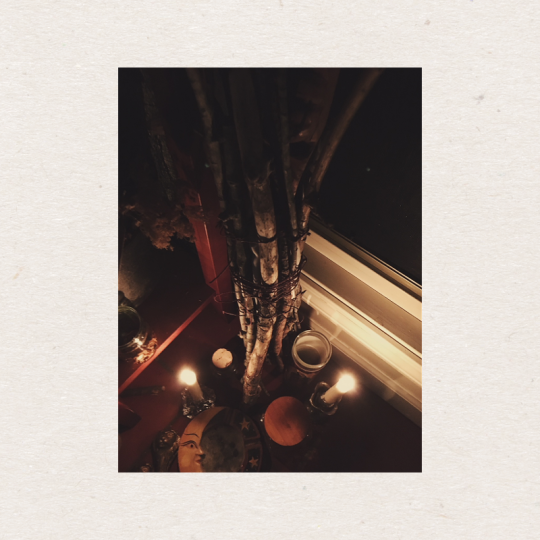
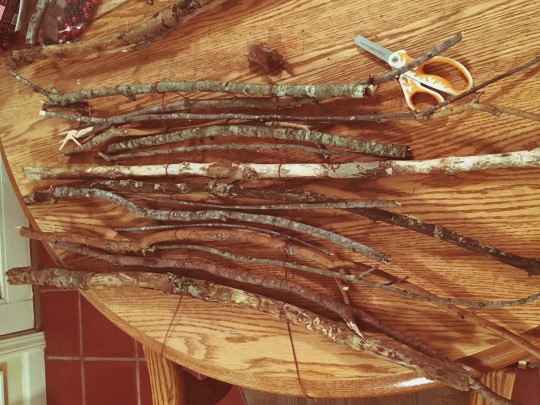
  • Sticks — (in the above photo) you can see I used sticks of varying sizes, but all of which were collected at local cemeteries
  • Twine
  • Clay — I used natural, air dry clay; but if you happen to have (or have access to) a kiln, actual clay would be ideal; avoid plastic-based polymer clays
  • Batting — I used Spanish moss; natural fibers are best; an old (clean) bird’s nest would work well, I imagine
  • Fluidum vītae*
  • Wire
  • Paper
  • Tobacco/Incense

Optional:

  • Paint and/or other decorative elements
  • Rum or other offerings

* By fluidum vītae I mean blood or sexual fluids. Ideally, an animal sacrifice would be made and the blood collected, but to tie the spirit to yourself blood, vaginal fluid, menstrual blood or semen can all be used.


Instructions:

  1. Begin by collecting your sticks. It’s not necessary to go digging through cemetery refuse piles at the stroke of midnight under the light of the waxing moon (like some witches who will not be named: me), store-bought is fine. No, but really, just go out and get some sticks. Feel free to gather them from specific locations or of particular species that correspond to your aims in constructing this spirit. For example, sticks from your own property (cedar or oak) would work splendidly if you seek to create a protective spirit. Employ whatever correspondences personal or traditional. Try to keep the sticks no longer than your arm, and no wider than your thumb or they will be unruly to work with in the next step.
  2. Once collected, the sticks must be fashioned into a sort of flexible mat that will be rolled and fastened later. Have patience. While it seems quite simple, working with a long length of twine can get tedious, especially at the beginning. Take the first stick and anchor two lengths of twine onto it near the center, leaving 6 to 8 inches between them. The rest is a bit like a puzzle, taking each stick and finding which fits well with the one beside it. You needn’t do this all at once, I simply tried fitting each as I moved along. Once you find one that fits,  secure it with twine: I used overhand knots because they’re easy and can be moved and tightened accordingly, the ones on the left going over and those on the right under (or vice versa). It’s a bit like macrame. If you know better knots or methods, by all means employ them. Make sure to leave the long tails of twine, as these will be used later to fasten the bundle.
  3. Once you have woven the sticks together, it is time to work on crafting a figure. As I mentioned above, this doesn’t need to be a clay figure, but could be a small doll or stone or whatever makes sense to you. I have a penchant for sympathetic magic, so I simply molded a little, nondescript figure. Once it is complete and fully dry, take it and sit with it. Consider for what purpose you are constructing this spirit, what will its function be, and allow its characteristics to manifest. This is very much a sort of negotiation: the ambient energy can manifest in certain ways, you must sculpt it and guide it to meet your goals. Do not underestimate the power of music. Choose songs with intention. Now is NOT the time to hit shuffle. Once the spirit is assembled, and time has been spent with it, prepare the figure with smoke. I’m prefer tobacco because with each exhale you can impart its function, responsibilities, arrangements and characteristics. I suppose the same could be done with passes through incense smoke. The most important part is to give this spirit a name. Knowing its traits and appearance, you can decorate the figure to match. But not yet is the spirit tied to the figure.
  4. To do this, scrawl the given name on a square of paper and roll it into a scroll. Dress the figure with the fluidum vītae (if you elected to do a sacrifice, make sure you specify what the sacrifice is for; don’t be wasteful), imparting “life,” and wrap the scroll around the figure with wire. Make clear the association of the spirit and the figure, call it by its name, give it the power it needs.
  5. Place this fetish on the batting. Being that I used Spanish moss and it has a tendency to be messy, I also used a square of white fabric, placing upon in the nest of dry moss, then the figure. Make sure the fetish is nicely nestled, adding more batting if necessary. I then folded the cloth over it and tied either end like a nice, witchy Tootsie Roll. Place the assemblage on the mat or sticks and bring each end of the mat to meet. A little overlap is fine. Using the twine tails wrap the entire bundle, fastening it with an impermanent knot (in case you need to disassemble it).
  6. It is good form to present an immediate offering, and do choose one that matches the ascribed function of the spirit. Rum is a great general offering, given its fiery nature, but if you’re not looking to incite the spirit to action, perhaps something tamer is in order.
  7. If you find a bundle of sticks unsightly, feel free to decorate the exterior with appropriately colored ribbon. It’s also good to place a small offering dish before it so that occasional gifts might be easily presented.
Standard

qedavathegrey:

Our Queen reigns:
Bedecked in Venusian shrouds,
Clutching at the twisting trident serpent,
A mad frenzy overcomes her –
She is the one at the site of creation,
She is the one who rains destruction,
She is the breather of life;
Our Lady of Desire –
She is love’s inspiration,
She is humankind’s temptation,
Embody the Divine Fire,
And consume us. 

I compiled a {Spotify} playlist to show a little love to the Red Queen! Hope you all enjoy. ❤

Did some adding and reworking: check it out!

Image

Our Queen reigns:
Bedecked in Venusian shrouds,
Clutching at the twisting trident serpent,
A mad frenzy overcomes her –
She is the one at the site of creation,
She is the one who rains destruction,
She is the breather of life;
Our Lady of Desire –
She is love’s inspiration,
She is humankind’s temptation,
Embody the Divine Fire,
And consume us. 

I compiled a {Spotify} playlist to show a little love to the Red Queen! Hope you all enjoy. ❤

Image

Attention:

qedavathegrey:

Hey, everyone! As I mentioned previously, I will be using this platform to collect information for a project I have been working on and am looking for willing participants to engage in a brief interview (likely no more than 5 or 10 questions). It shouldn’t be all that time consuming and you need only answer the questions which you are comfortable with answering.

I am looking for two types of participants:

  1. Sex workers who practice witchcraft, and/or identify as pagan – this applies to secular witches, as well!
  2. Sex workers who identify as Christian, Jewish, or Muslim and do not practice witchcraft.

Christian, Jewish and Muslim sex workers who practice witchcraft are also welcome! 

This extends to all genders, orientations, races, classes, and most types of sex work. If you think you may fit, but aren’t entirely sure, feel free to contact me for clarification!

All information you provide can be presented anonymously upon request (through the changing of your name, location, etc.), though for the interview, I will need you to provide some information that could be considered private. If you have questions, concerns, etc. I’d be more than happy to answer them before you would like to commit completely.

Please contact me here @qedavathegrey (preferably via message, not inbox – just so it’s easier to communicate and record) or at my e-mail: qedava.the.grey@gmail.com – the earlier the better, but the official deadline is April 30th, 2017.


If you cannot participate, I would very much like if you would reblog this to help me out! 

Thank you all so much!

Standard

Ecstatic Witchcraft

image

This is a post a long time in the making, as it is something
I’ve wanted to share for a while now, just because it is such an important part
of my own craft. There is something truly magical about it and is, for me,
something both very humbling and very empowering; as such, it is something that
I think is worth sharing.

Foremost, the question to address is: What is ecstatic witchcraft? And one not so easily answered, as
there cannot be any one way in which it is performed. It can (I think) be
described as a form of trance magic,
though its expression is not wholly tied to trance in the traditional sense. In
essence, it is a surrendering of self and its simultaneous expression. It is a
temporary shedding of the façade one erects to survive, Freud called it the superego and without it, so too falls
away the ego. The goal of ecstatic witchcraft – if it can be called a goal – is
to allow the id to manifest unencumbered, a means of channeling the primality.
Of course, this manifests in innumerable ways and no two sessions would ever be
the same, hence why it can be so tricky to pin down precisely.

I’ve found that – and it continues still – that the
witchcraft community (predominately) has long perpetuated the notion of control
as being paramount to success, and while this may be true to some extent, I
believe the converse must also be explored. There is law and there is rigidity,
there is correspondence memorization and a lot of book work: and this makes
sense! For the last century (and in times before), this has been the main means
of information acquisition. While it is not uncommon for witches to join
groups, covens, etc., I’m willing to bet that most practicing witches were
indoctrinated through solitary study. Again, there is nothing wrong with this,
and I, myself, am contributing to this reservoir of written information as I
type! But, as I mentioned, while I did my fair share of book work and
memorization, the heart of my Craft has always been exploration. Tradition is
important, but it’s never been enough for me. I’ve said it once and I’ll say it
again: the best way to learn is to do.
There will be mistakes; you will come to conclusions only to find things that
defy them; you will learn to correct; you will learn to be skeptical, but not judgmental.
You will learn there are a thousand purported ‘right’ ways, and then you will
find your own. Nothing is static.

How does this relate then, to ecstatic witchcraft? It is a means by which to connect to that instinct: that intuition that drives
us – shedding preconceived notions and allowing the opportunity for exploration
through action. And action, I feel, is the root of ecstatic magic.

How To Perform Ecstatic Witchcraft

As I mentioned previously, there is no right way and I can only provide to you a number of facets of
expression that are conducive to ecstatic witchcraft. These are by no means the
only facets, and as always, I encourage you to explore what works for you.

  • Speak – It may seem counterintuitive to what I have said,
    for is speech not a construct? It is, but there is power in vocalization, even
    if speaking unintelligibly. This is an extension of opaque language – or language
    spoken ceremonially as a means of excluding those who are not privy to the
    religious tongue – and moves into the realm of glossolalia. Rarely do I include
    verbal scripts to be read in the things I post, as I find that they detract
    from the working themselves, instead encouraging those performing to speak what
    comes. This is a more controlled form of ecstatic witchcraft – bound by
    intention, time, and often language itself. Here, let all that fall away and
    simply: Speak.
  • Move – Ecstatic witchcraft, for me, is all about energy:
    movement, especially. It is best not to go into it with any plan, simply follow
    where your body takes you. If it says run, run; if it says dance, dance; if it says
    squat and howl like a wolf, by gods do it! It is for this and many reasons that
    ecstatic magic should be done in a controlled setting, normally somewhere safe –
    but I should mention, this need not be done alone! Ecstatic witchcraft can just
    as easily be done in groups, though it can get a little more dangerous,
    considering the id is often noted as
    being the seat of sexuality and aggression. I also recommend putting sharp
    objects away – you never know what the hype might bring – but hey, sometimes
    you just really need to throw a knife; perform responsibly.
  • Draw/Write – Admittedly, some of my coolest and most
    profound sigils have come from ecstatic sessions! There is something in me that
    always wants to take chalk and just go to town on every surface around –
    overtaken by mania. Automatic writing is related, in some ways, though often it
    is used with intent: channeling a specific spirit, deity, etc. Ecstatic magic
    requires no such formalities, bending to the whims of all and none, the witch
    is then but an instrument of the spirit: of the cosmos.
  • Laugh – Laughter is powerful.
  • Instruments – If you have at your disposal some musical
    instruments (I prefer maracas and tambourines), bring them in! And forget what
    you think you know about music, just roll with it. Hell, if you want to
    continuously shake a maraca and scream with one foot in the air, do it. Again,
    it’s all about energy, and instruments bring their own, unique vibes to the
    table.

Entheogens – *at your own risk; use responsibly* Sure, they
might compromise some of the safety, but they also bring an entirely new level
of exploration. For some. My use of entheogens in the past have always been hit-or-miss; sometimes they are conducive and other times they are hampering. Know
what works for you, and be careful: you don’t want to show up at the nearest E.R. naked, tripping on an unknown substance with a painted face and defiantly shaking a maraca.

Sex – This harkens back to what I said about working in
groups, sometimes there is a power in it, and the same can be said for adding
sex in. When working with others, always plan for the possibility of sex!
Especially with who you invite in, and in regards to safety. I don’t know the
last time it was used, but the “It was for ecstatic witchcraft” excuse will not
hold up: while it may sound like a damper, J.I.C. consent agreements and
activity do’s and don’t’s should always be agreed upon beforehand, and should always be open to amendment. If
you really want to, draw a circle: anyone who leaves it is has removed
themselves from the session and should not be addressed until they reenter of
their own accord.


With that, I hope it is becoming clear what ecstatic
witchcraft is (or can be), its benefits and how it isn’t really all that new a
concept. It is, for me, a profound experience every time – I come out feeling
energized, powerful, but also with a new frame of mind, having shed societal constriction
and attuned with both the divine and animalistic parts of myself – if even for a moment. In that it is
humbling, and it is empowering.


Photo: Maenads,

John Collier 

Standard

Attention:

qedavathegrey:

Hey, everyone! As I mentioned previously, I will be using this platform to collect information for a project I have been working on and am looking for willing participants to engage in a brief interview (likely no more than 5 or 10 questions). It shouldn’t be all that time consuming and you need only answer the questions which you are comfortable with answering.

I am looking for two types of participants:

  1. Sex workers who practice witchcraft, and/or identify as pagan – this applies to secular witches, as well!
  2. Sex workers who identify as Christian, Jewish, or Muslim and do not practice witchcraft.

Christian, Jewish and Muslim sex workers who practice witchcraft are also welcome! 

This extends to all genders, orientations, races, classes, and most types of sex work. If you think you may fit, but aren’t entirely sure, feel free to contact me for clarification!

All information you provide can be presented anonymously upon request (through the changing of your name, location, etc.), though for the interview, I will need you to provide some information that could be considered private. If you have questions, concerns, etc. I’d be more than happy to answer them before you would like to commit completely.

Please contact me here @qedavathegrey (preferably via message, not inbox – just so it’s easier to communicate and record) or at my e-mail: qedava.the.grey@gmail.com – the earlier the better, but the official deadline is April 30th, 2017.


If you cannot participate, I would very much like if you would reblog this to help me out! 

Thank you all so much!

Standard

Attention:

Hey, everyone! As I mentioned previously, I will be using this platform to collect information for a project I have been working on and am looking for willing participants to engage in a brief interview (likely no more than 5 or 10 questions). It shouldn’t be all that time consuming and you need only answer the questions which you are comfortable with answering.

I am looking for two types of participants:

  1. Sex workers who practice witchcraft, and/or identify as pagan – this applies to secular witches, as well!
  2. Sex workers who identify as Christian, Jewish, or Muslim and do not practice witchcraft.

Christian, Jewish and Muslim sex workers who practice witchcraft are also welcome! 

This extends to all genders, orientations, races, classes, and most types of sex work. If you think you may fit, but aren’t entirely sure, feel free to contact me for clarification!

All information you provide can be presented anonymously upon request (through the changing of your name, location, etc.), though for the interview, I will need you to provide some information that could be considered private. If you have questions, concerns, etc. I’d be more than happy to answer them before you would like to commit completely.

Please contact me here @qedavathegrey (preferably via message, not inbox – just so it’s easier to communicate and record) or at my e-mail: qedava.the.grey@gmail.com – the earlier the better, but the official deadline is April 30th, 2017.


If you cannot participate, I would very much like if you would reblog this to help me out! 

Thank you all so much!

Standard

The Witches’ Web

It’s no secret, I have a strong connection to spiders, and as such, find myself working with strings, thread and yarn often. Knitting, braiding, macrame – it’s something I get from my grandfather, I imagine, who had countless books on knots and his own penchant for cordage. Of course, his stemmed from being bedridden with a broken back in his formative years. I was lucky enough to pick up the hobby without being confined.

This particular project came out of the blue. One day, having yarn and a large portrait frame at my disposal (with nails jutting from the back in disarray), I wove myself a web – it was messy, but in time, I found myself repeating the process again and again: without reason. I would simply hang them or stow them away for lack of any use. It was only after a time that I discovered their many uses.

Foremost, they work well as snares for any unsavory spirits, especially when protective charms are woven or placed within them. Feathers, chicken feet, and bones all hold very well, but you can also add in ribbons, strings, beads, whatever works for you. Alternately, they can be used in works of control and binding, imparting subtle or aggressive influence on a situation or individual. Such can be done by fastening a photos and/or personal affects/concerns into the web. Lastly, and my favorite use, is that there is an innate interconnectedness and within can be found the manifestations of one’s destiny. It isn’t necessarily an art that I can describe, but with patience, you may be able to attune to what the web can show you. Trace the strands and follow.

Things You Will Need

  • Framethis can really be anything; I’ve used picture frames, embroidery hoops, wreaths, willow rings, though I have found that sturdier, even frames make for a tighter, more uniform web; square or round, either work
  • Cordageyarn, twine, thread (though I recommend using cotton, as synthetic is usually too slick to hold with friction), embroidery floss (my personal favorite), etc.
  • Optional: trinkets, curios, charms, etc.

Instructions

  1. Secure some anchor strands to the frame. The number doesn’t matter, though the more you use the more intricate the pattern (but the longer and more complicated the process). These strands should extend the diameter and meet at a central point: the first strand is simply secured on both sides, and the subsequent should be looped around the central point so as to have a concrete point to work out from.
  2. Next, cut a long strand. To get an estimate for how long it needs to be, simply wind it over the top of the strands in a spiral of roughly the shame size as you wish to create. You don’t lose much in the process, so there’s no need to allot excess EXCEPT that you’re going to need to anchor the final strand to the frame, as well. Better to have too much than too little. 
  3. You will then need to anchor the thread through the center. My preferred method (when using embroidery floss or yarn) is to thread the cord onto a needle (as you would when embroidering – i.e. no need to double it up) and knot the end. Bring this through the center (carefully, to check to make sure the knot catches) and then move out along one the the strands and make another securing knot. This is where you will begin, so go out only so far as you wish the smallest point of the spiral to be. This will vary based on the size of the web you’re weaving.
  4. Remove the needle (you could keep it on, but I find it just gets in the way of things) and move the string over the next strand, then bring it around and under the same anchor. Continue this process, spiraling outward. It can take some time to get the hang of it, and don’t fret if as you go the more central strands develop some slack, as once you’re finished, the threads can be spaced out. It is important, however, to continue the spiral in the same trajectory, even when the strands gravitate toward the center. If you compensate, you’ll wind up with a loose weave. Just continue to follow the growing spiral.
  5. Once you’ve made it to the edge, fasten the strand over the top of the nearest anchor, and you’re done! Voila!

photo: this is just a small (somewhat messy) one I made today, as my others are still packed away, though if you really have literally nothing to do, I’m sure you could find a picture of my giant one in my archive

Standard