
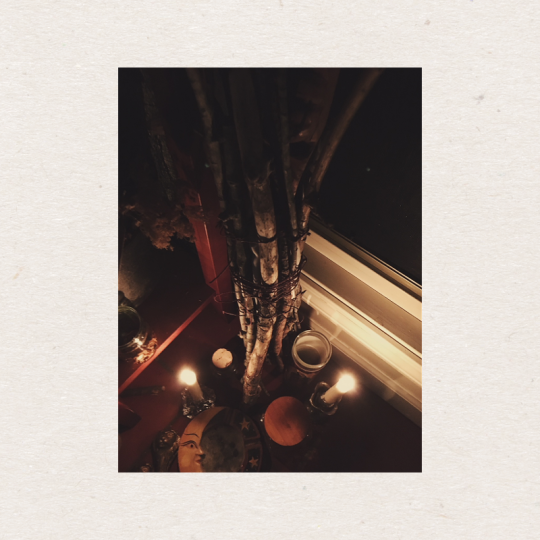
Despite the title, to simply call this a means by which to trap a spirit is to disregard its main function. In actuality, the spirit snare is more accurately not only an abode for the spirit, but a tool to be used in the construction of spirit. This will become clear as you read below, but first I must preface by saying that the “skeleton” — the underlying structure — of this ritual can be adapted with a nearly boundless collection of replacement tools, ingredients, etc., e.g. while the following will incorporate a clay figure, this could be replaced with a doll (cloth, stick, etc.), a stone, really anything. What matters is the action and process, not necessarily the materials listed. With that being said, take this as an example, not the definitive or singular way to accomplish the same task.
For this method, you will need a few “ingredients:”
- Sticks — (in the above photo) you can see I used sticks of varying sizes, but all of which were collected at local cemeteries
- Twine
- Clay — I used natural, air dry clay; but if you happen to have (or have access to) a kiln, actual clay would be ideal; avoid plastic-based polymer clays
- Batting — I used Spanish moss; natural fibers are best; an old (clean) bird’s nest would work well, I imagine
- Fluidum vītae*
- Wire
- Paper
- Tobacco/Incense
Optional:
- Paint and/or other decorative elements
- Rum or other offerings
* By fluidum vītae I mean blood or sexual fluids. Ideally, an animal sacrifice would be made and the blood collected, but to tie the spirit to yourself blood, vaginal fluid, menstrual blood or semen can all be used.
Instructions:
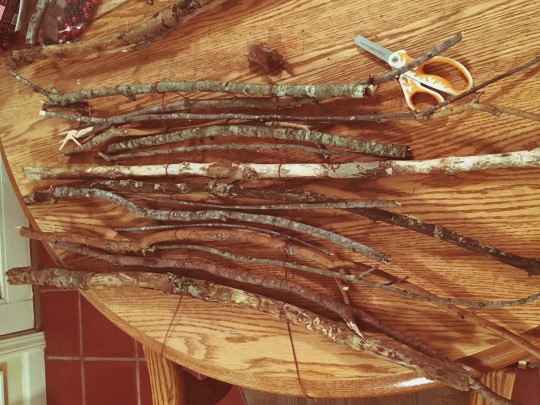
- Begin by collecting your sticks. It’s not necessary to go digging through cemetery refuse piles at the stroke of midnight under the light of the waxing moon (like some witches who will not be named: me), store-bought is fine. No, but really, just go out and get some sticks. Feel free to gather them from specific locations or of particular species that correspond to your aims in constructing this spirit. For example, sticks from your own property (cedar or oak) would work splendidly if you seek to create a protective spirit. Employ whatever correspondences personal or traditional. Try to keep the sticks no longer than your arm, and no wider than your thumb or they will be unruly to work with in the next step.
- Once collected, the sticks must be fashioned into a sort of flexible mat that will be rolled and fastened later. Have patience. While it seems quite simple, working with a long length of twine can get tedious, especially at the beginning. Take the first stick and anchor two lengths of twine onto it near the center, leaving 6 to 8 inches between them. The rest is a bit like a puzzle, taking each stick and finding which fits well with the one beside it. You needn’t do this all at once, I simply tried fitting each as I moved along. Once you find one that fits, secure it with twine: I used overhand knots because they’re easy and can be moved and tightened accordingly, the ones on the left going over and those on the right under (or vice versa). It’s a bit like macrame. If you know better knots or methods, by all means employ them. Make sure to leave the long tails of twine, as these will be used later to fasten the bundle.
- Once you have woven the sticks together, it is time to work on crafting a figure. As I mentioned above, this doesn’t need to be a clay figure, but could be a small doll or stone or whatever makes sense to you. I have a penchant for sympathetic magic, so I simply molded a little, nondescript figure. Once it is complete and fully dry, take it and sit with it. Consider for what purpose you are constructing this spirit, what will its function be, and allow its characteristics to manifest. This is very much a sort of negotiation: the ambient energy can manifest in certain ways, you must sculpt it and guide it to meet your goals. Do not underestimate the power of music. Choose songs with intention. Now is NOT the time to hit shuffle. Once the spirit is assembled, and time has been spent with it, prepare the figure with smoke. I’m prefer tobacco because with each exhale you can impart its function, responsibilities, arrangements and characteristics. I suppose the same could be done with passes through incense smoke. The most important part is to give this spirit a name. Knowing its traits and appearance, you can decorate the figure to match. But not yet is the spirit tied to the figure.
- To do this, scrawl the given name on a square of paper and roll it into a scroll. Dress the figure with the fluidum vītae (if you elected to do a sacrifice, make sure you specify what the sacrifice is for; don’t be wasteful), imparting “life,” and wrap the scroll around the figure with wire. Make clear the association of the spirit and the figure, call it by its name, give it the power it needs.
- Place this fetish on the batting. Being that I used Spanish moss and it has a tendency to be messy, I also used a square of white fabric, placing upon in the nest of dry moss, then the figure. Make sure the fetish is nicely nestled, adding more batting if necessary. I then folded the cloth over it and tied either end like a nice, witchy Tootsie Roll. Place the assemblage on the mat or sticks and bring each end of the mat to meet. A little overlap is fine. Using the twine tails wrap the entire bundle, fastening it with an impermanent knot (in case you need to disassemble it).
- It is good form to present an immediate offering, and do choose one that matches the ascribed function of the spirit. Rum is a great general offering, given its fiery nature, but if you’re not looking to incite the spirit to action, perhaps something tamer is in order.
- If you find a bundle of sticks unsightly, feel free to decorate the exterior with appropriately colored ribbon. It’s also good to place a small offering dish before it so that occasional gifts might be easily presented.


 The Qedavian Apocrypha