A Vision

This was an experience I had a few nights ago that boundaried
somewhere between dream and vision – through my own sort of meditation (I
really can’t do the whole, traditional, sitting meditation – I must be moving
or doing a repetitive task). This came through, however, when I was not looking
to receive any messages. It just sort of hit me – out of the blue. It’s quite
obviously related to my recent post regarding the Minoan Great Goddess, and due
to a few inquiries, I thought I’d share the experience for all those dealing
with similar situations. I’ll undoubtedly be following this up with a number of
related dreams.

As with most “visions,” this one came very fluidly. While
circumstances and positions were changing, they did so abruptly, but not
segmentally, as I’m sure will become clear.


With that being said, this was the Vision:

It began with a woman. She was massive – her crowned-head
divided the clouds above, and her feet rested proudly on either side of a rocky
mountain. She wore layered clothing, though the exact details of which I can’t recall.
I do, however, remember her dress/robe being a cream color with a length of
crimson fabric decorating her shoulders. She wore a golden crown that had an
evident, helmet-like motif, and from which cascaded a curtain of long, dark
hair. It wasn’t black, but instead a very deep, dark shade of brown –
almost like raw umber. She stood atop the mountain, which paled in size to her great
stature, swathed in gold. The sky seemed to embrace her, wrapping around her
like a cloud-veil, without masking her face which beamed down with knowing
eyes, the sparkle of humor and an ecstatic penchant for warfare. There was
undoubtedly a militant air, but one in balance with the other facets of
herself. She was a Warrior, but it was not her only claim.

In her hands she carried the golden labrys – which looked
oversized in her hand, as though it would weigh any mortal’s arms to the ground
– but it was naught but an extension of her, evident in the ease with which she
wielded it. I looked to her and she, with a proud and playful smile, returned
my gaze.


As soon as she did, she began to spin. She danced at the
craggy foot of the mountain, spinning and dancing like a dervish, all the while
letting the axe hang and swing with her. A joyous laughter echoed against the
stone, mingling with the sound of her bare feet slapping gently on the rock.
Just as she’d reached her fastest pace, she let loose the labrys and it
rocketed skyward – and I, along with it.


Suddenly, by the same hand, it was snatched from mid-air and
brought down viciously against a frightful creature. She was in the heat of
battle, surrounded on all sides by foes and comrades alike, expertly cutting
down with swift and serpentine motion all who stood to face her. Never have I
seen a weapon (of any sort) so skillfully willed as the labrys in her hand.
With one hand she sliced her enemies in two (or four…), in such a beautiful way
that it was as though she were dancing – the axe her baton. She would twirl the
blades above her head on a single palm then put them through the cheeks of her
aggressor – who surrounded her on all sides. In every direction, she struck
them down, writhing like a snake, turning like a top. Someone called to her
from across the battlefield and her head whipped to face them with curiosity.


I was in the mountain, then – running at top speed.
Throughout its stone body was an intricate, labyrinthine set of cave-tunnels – at first
lit by torches, but then by nothing at all. I ran as fast as I could, pursued
by an unseen evil that sounded like barking hounds and screeching bats. Though
I could not see through the darkness, I ran trustingly – Guided by the Goddess,
I leapt, dodged and scaled all that impeded my path. I ran my fingernails
against the cave walls that suddenly opened into a room – lit above by a single
sky-light. A heavy stone door closed behind me, the heavy grinding noise a
testament to its great, impenetrable weight. She was waiting there – in the
cavern – the labrys still in her hand. She circled me, the axe hand poised at
her side, the blades resting just above the floor. Around me she slinked, like
a feral beast surrounding her prey. Her eyes were lidded, looking unto my like
a cat unto a mouse. She paused for a fraction of a second and from my waist I
produced a dagger, parrying the swing of her axe down on me.


She swung again, and I twirled the dagger in my hand,
side-stepping and using its hilt to bring the axe down away from me and placing
a foot solid between her squared feet. With lightning quickness, she released
the labrys and used the same hand to grab my wrist and twist the dagger from my
grip. I drove a hand to her throat and the two of us both went down – now in a
full grapple. I growled and she laughed heartily, working my arm behind my
back. I used my toes to overturn myself, landing on her, using my other elbow
to jab her in the rib. She let loose of my hand long enough for me to snatch it
away, but she simply rolled backward, immediately on her feet, and lunging at
me again. Reflexively, my hand shot up at her throat and, at the same
instance, we both took the other’s neck in our nails. She smiled a devilish
smile, and we released each other. I dabbed the sweat from my forehead with my
forearm, while she rose her clawed fists in front of her face. She came at me
again, and again, I put my feet between hers, this time snatching her wrist and
spinning her over me. She landed, agile as a cat, on her feet and landed a bare
foot directly to my stomach – knocking me back against the cavern wall. I fell
to the floor, doubling over in pain. She approached slowly, silently, but with
an accomplished smirk on her face. She came to me, and offered me a hand up,
but my face was yet to the ground. As my arm moved, I took hold of her ankle
and yanked it out from under her, my other hand making contact with her
discarded labrys that had been within my reach. She fell flat and I spun the
labrys around and held it to her throat – then flashed her my own satisfied
grin, to which she responded with a proud smile and an echoing laugh.


Suddenly, the stone door began to grind open and I
immediately looked to it – and when I looked back, she was gone, but in my
hands remained the labrys.


image source 1 2

Standard

Minoan Great Goddess

My dreams recently have been leading. For a while now, I’ve
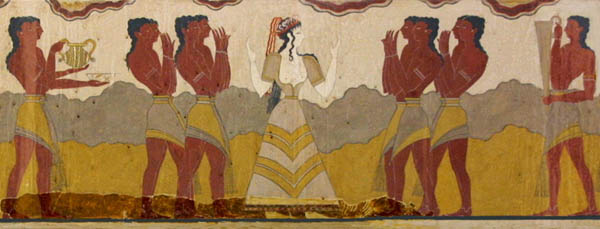
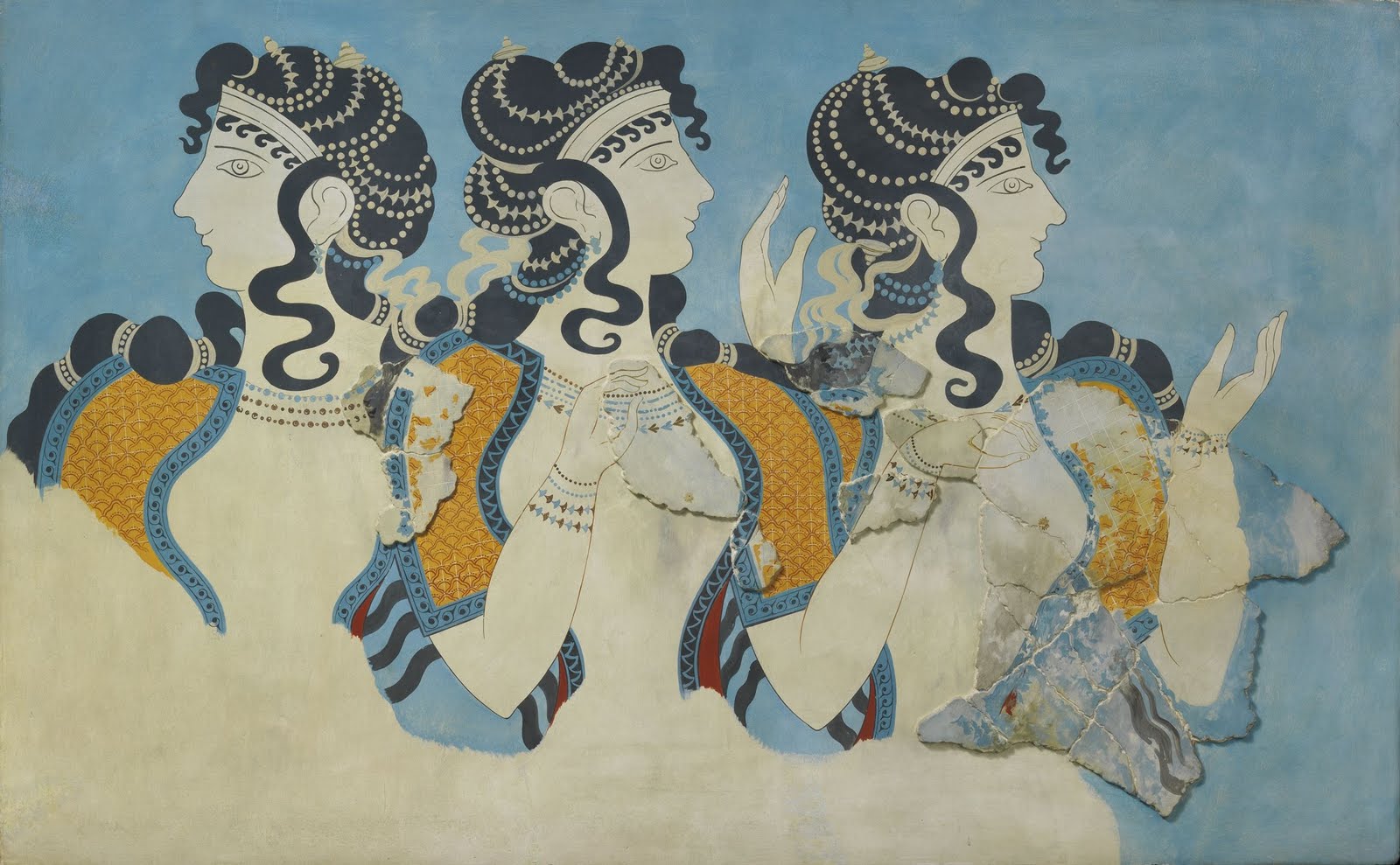
wanted to write something on the “Ariadne,” or more accurately, the Mistress of the Labyrinth from Minoan
lore. I’ve always been fascinated by Minoan religion for a number of reasons.
Foremost being their exclusively matriarchal pantheon that served for much
inspiration in regards to most of the Greek goddesses. I probably also love it
in no small part for the great mystery that still surrounds it – what with
Linear A and the Cretan hieroglyphs still yet indecipherable. I can’t help it –
I love a good mystery. And recently, I’ve sought to explore and explain it
through a most interesting source – one that existed a world away. As such, I’ll
preface this by saying this is very much theoretical – I can produce no
concrete evidence, but nonetheless, I find it interesting. And as they say, you
can’t apply evidence without first framing a hypothesis.

image

Given the obscuration still surrounding the Minoan mythos,
we must first begin with its successor – and most importantly with the myth of
Persephone, which I’m sure most of you are familiar with. Both of her “aspects”
– as an agricultural/fertility goddess and a chthonic one – are very important
for the correlations I will make in regards to the Aztec pantheon. While the
similarity is obvious, it’s not extraordinarily well noted in regards to the
Aztec goddess Xochiquetzal, who undergoes a nearly identical circumstance. She,
too, was an agricultural/fertility goddess before her abduction by Tezcatlipoca
– at which point she was irrevocably forced into chthonic divinity. And while
these similarities in and of themselves are interesting, the real weight comes
with their elder counterparts, as both are believed to be manifestations of
elder figures reworked into the framework of inclusive faiths. Looking at
Xochiquetzal, I believe, might grant insight into the history of Persephone –
given the obvious enough similarity.

image

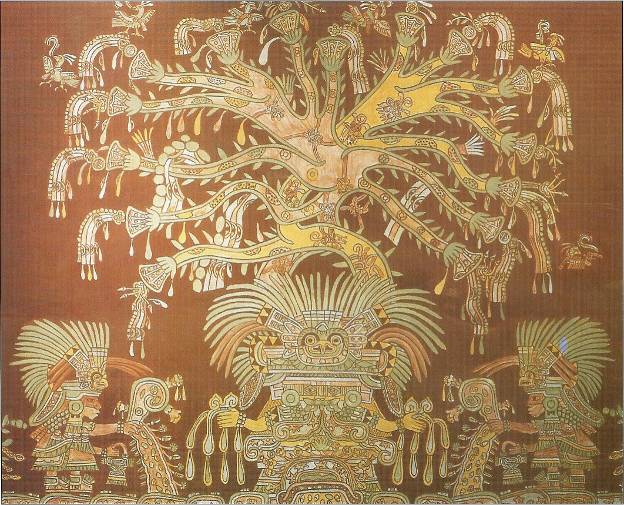
It’s been postulated that Xochiquetzal may in fact be tied
to the unnamed Spider Goddess of Teotihuacan – who is an interesting figure in
her own right. She was thought to be a Great Goddess, an instrument in the
creation of man and was rightly also tied to agriculture and fertility (as well
as being tied to War) – though most intriguingly, she most often appears
bedecked in characteristic items and dress (as well as with animals) that were all
characteristic Mesoamerican symbols of the Underworld (including but not
limited to both the Spider and the Jaguar). While her worship seemed to be quite
local (reserved mostly to Teotihuacan, wherein she acted as patroness), I would
argue her archetype would most probably be left over from older beliefs. As
such, it would make sense for this duality to persist on into the Aztec
incarnation of Xochiquetzal – who existed dually in the same capacity. Of
course, given her abduction, this capacity would no longer be innate –
something that can be seen with the patriarchal overthrow of the matriarchy. I
would posit that undoubtedly, in both regards these “abductions” were but a way
to explain the already existing nature of these beings, but with a way to incorporate
male divinity as justification. Assuming the correlation between Xochiquetzal
and the Spider Goddess is rightly, I think we can assume that Persephone
undoubtedly existed similarly as a Great Goddess before her annexation.

image

I’m inclined to believe that Persephone and Ariadne are in
fact two heads of the same coin – both later aspects of who had been called The Mistress of the Labyrinth. While
Ariadne’s story is far more obviously related (as the daughter of King Minos of
Knossos, and her story featuring the Cretan Labyrinth and the Minotaur – which on
a side note was no doubt related to the bull worship that seemed to be a common
Minoan practice), the Chthonic aspect thusly suggest to me a correlation – which
is in no small part also due to the Aztec mythology, specifically that
surrounding Tezcatlipoca and divination. It has been noted that the Aztecs used
obsidian mirrors to scry, the act of which was likened to fire caught in a pool
of water (as the obsidian was often placed on the bottom of a vessel that was
then filled with water, the visions therein were the “fire.”) This concept
extends to the idea of a butterfly caught within a spider’s web. The Aztecs
held spiders to be related to water – given the fractal waves can be reminiscent
of a web, and the butterfly related to fire. Not surprisingly, one of the
animals associated with Xochiquetzal was the butterfly (and as previously
mentioned, the Spider in her previous incarnation – further cutting
Tezcatlipoca’s true relevance down). But it was not only the Aztecs who revered
butterflies, but the Minoans – as the labyrs. The double-headed ax and the
butterfly – both of which being symbols of their Great Goddess, The Huntress. Unsurprisingly, based on
her name, Artemis (and Rhea) were most probably born from her. She was known to
be the keeper of wilds, guardian of animals and made her home in/on the
mountain (it was in the mountains that the system of sacred, labyrinthine caves
existed – which will prove to be important later) – it’s also important to note
that the Great Goddess acted as creator immaculately, reminiscent of Artemis as
a Virgin Goddess and Rhea as Mother Goddess.

image

Fun Fact: Artemis and Xochiquetzal are both twins. Their
brothers. Apollo(n) and Xochipilli, both act as solar, entheogenically-inclined,
oracular deities – relating to arts, markets, music, enlightenment and homosexuality
– though Apollo wasn’t the only one.


With this, we have presented The Huntress, the butterfly, and the Mistress of the Labyrinth, the spider (which weaves labyrinthine
webs). Agricultural/fertility and chthonic, respectively. My theory is that,
while both of these Goddesses were unique, they were aspects of one another. The Huntress – as Artemis, Rhea, Kore/Demeter,
even Xochiquetzal – were the lighter aspects. The Mistress of the Labyrinth,
alternately, represents the darker and more mysterious, chthonic aspects of the
Great Goddess – such as with Persephone, the other half of the Spider Goddess
(perhaps as Tezcatlipoca), and Ariadne. The
Huntress
is the Mountain, and The
Mistress
is the Cave. As such, it would not surprise me if the entire
Minoan pantheon were merely aspects of a singular, Great Goddess – whose aspects
were adopted into polytheistic Gods by the so-inclined Greeks (such as Hera,
Demeter, Artemis, Athena, etc.). I think with time there will be discoveries
made to back this conclusion up, though I highly doubt they’ll compare them to
an “autonomous” pantheon such as the Aztecs. But rest assured, I will be eagerly
awaiting new evidence to surface and Linear A to finally be deciphered!


in-text image source: 1 2 3 4

Image

Spider Queen


This is simply a record of a dream I had a few years ago, as such, feel free to disregard or speculate as to who the figure therein may be, because I’m still not entirely sure, but I know that since the dream, I have seen her many times – most often in regards to art, such as when I’m painting or weaving. She makes her presence known and watches, but says nothing and always leaves as abruptly as she arrives.


This dream happened within a series of dreams I had about Doors. While this one happened after the original, this one has been the one that has burned itself most vividly into my memory. It is as follows:

I am in the darkness – one that is so frightfully black, it seems to devour all light and even sound – as I’ve heard many describe a mine as being light. It is a palpable darkness, one that seems to the eyes as to move. And then there was a glow. It was very faint at first, before my eyes became adjusted to its softness. It was most skin to a sort of bioluminescence, though it was the floor that emitted it – calling attention to grand in size the cavern was. The scale was unbelievable. Columns shot up on either side into the blackness above, which the floor could not illuminate. The walls bore carvings, but I couldn’t make them out at such a point.

I began to walk forward, with every step my eyes were able to make out more and more through the blackness overhead – but as I came nearer and nearer to the end of the hall, I took not of the barely glimmering filaments before me. And as I walked, the filaments that hung from above began to part like a great curtain, and I saw then that on the end of each strand was a spider. They parted as I walked, scurrying toward either wall in such a way the formed a blanketed canopy on either side of me. It was then I noticed that it was not the floor that was glowing, but the light from beneath a door I was walking toward – which crept underneath in a lilac-tinted haze.

There are few words to describe how large the door was. It was monumental, rising straight up for what could have been a hundred, two hundred feet straight up – and every inch of their surface bore the same etchings as before, only now they were visible. I don’t remember them specifically, but they looked to be Mayan. However, while there were the characteristic sections of sectioned words that Mayan is known for – they are chunked into squares that form words – there were also great, stela, relief scenes of what looked to be a battle or story. As I said, I can’t remember the exacts of what was depicted thereon, but I remember it being a great and impressive thing to behold. And as I came to the door, the glowing from beneath grew stronger and painted me in a matching hue. I remember being thinking I should be in awe of such a grand piece of art and craftsmanship, but I wasn’t – as though I had seen it thousands of times.

I touched the face of the door, and without an ounce of exertion, the whole giant door (it was actually a set of double doors, I opened the right half) swung with a grinding noise as the stone moved over stone and the lilac light ceased and the cavern – which was just as massive – was lit overhead by one sky-light. The cavern, which was not nearly as wide as it was tall, shot upwards through what could be best described as clouds – though it was more of a mist. However, I think that speaks for the grandiosity of the cavern, that it was so large it had developed its own climate. It was through the clouds that the light shone done in a single column, illuminating a towering stalagmite. But it was still note a sense of awe that came over me, but one of dread. It was not fear, though it probably should have been, but it was more like a sense of discomfort. Such as the feeling you get when you’re about to do something you really don’t want to do. A “happy” blend of anxiety and annoyance.

I walked into the cave – and found that around the stalagmite was a “moat” of sorts, but filled with a foreboding, black “water.” Like the sea at night, when nothing can be seen through it. I turned left, following the path of stone around the moat, but keeping my eyes firmly on the tip of the stalagmite. And as I came around the bend, I saw her sitting there. The top 1/3 of the stalagmite had been carved into a throne, and was occupied by one of the most ferocious looking women I have ever seen.

Her skin was grey – almost stone-like in color, but did not bear the sickly hue often associated with “grey-skin.” It glistened, damp in the humidity of the cavern. She wore a black dress, which I can’t remember very well, only that it had on obsidian glint to it, as though it was beaded with it. And atop her head was the most unforgettable “crown” – that appeared almost like an overturned spider, with eight, wicked legs pointing upward. I swear they may have even moved – but if they did it was very slowly.

I only got a peak at her face, but it was very angular – her cheekbones were the most prominent, her lips were a shade of dark purple, almost black – and it was obvious that they were naturally that color, not painted. And her eyes were a frighteningly light color for her complexion, either a very light grey, if not lilac themselves.

As I came around the throne, her eyes fixed on me and an instantaneous anger shot daggers from her eyes, and her long nails curved around the arms of her throne as she opened her mouth and screamed the most horrifying, blood curdling scream – one of extraordinary and evident anger. I simply stood there, my face unmoving, looking straight into her eyes.

That’s when I awoke. 

After which, when she appeared to watch me, she did not echo the same anger. She was by no means bright and sunny, but she did not exude the unimaginable anger that she did in the dream. She seemed distrustful, bitter, and aloof – which was by far better, in my book. When she appears, its as though she is checking in, to make sure I’ve “changed” – and when she sees that I have, she seems strangely bitter – almost as though she’s trying to catch me in a lie. And when she doesn’t, she just leaves. Every time, though, she gets less and less angry and more and more curious – the last time I saw her, she was leaning over my shoulder to look at something, with that curious sparkle people get in their eyes. When I turned to face her, I saw what may have been an intrigued smile on her face – but then she was gone.

Standard